

The Lada VFTS is a rally car based on the Lada 2105, which was launched in 1980 and was an evolution of the original Lada 1200 (VAZ 2101)Lada is a trademark of the Russian manufacturer AvtoVAZ, whose origins date back to the late 1960s when the Italian company Fiat and the Soviet Russian Ministry of Automotive Industry signed a contract to build the AvtoVAZ car factory in Stavropol, which was renamed Tolyatti for the occasion. In 1970, the first Lada rolled off the assembly line – a 2101, which was marketed in our region as the 1200. This four-door model, later also available as an estate — known as a Combi — was based on the Fiat 124, which was introduced in 1966 and voted ‘Car of the Year’ in 1967. |
 |
Lada 2105: Modified Suspension and Enlarged Engine for Enduring PerformanceThe Lada version received, among other things, a modified and slightly raised suspension, a body made from thicker steel sheet, and an engine with an overhead camshaft driven by a double timing chain. The Lada 2105, which debuted in 1980 and remained in production for 12 years, was immediately recognisable thanks to its more angular design, the absence of quarter windows in the front doors, and rectangular headlights. The engine's displacement increased to 1,596 cc. |
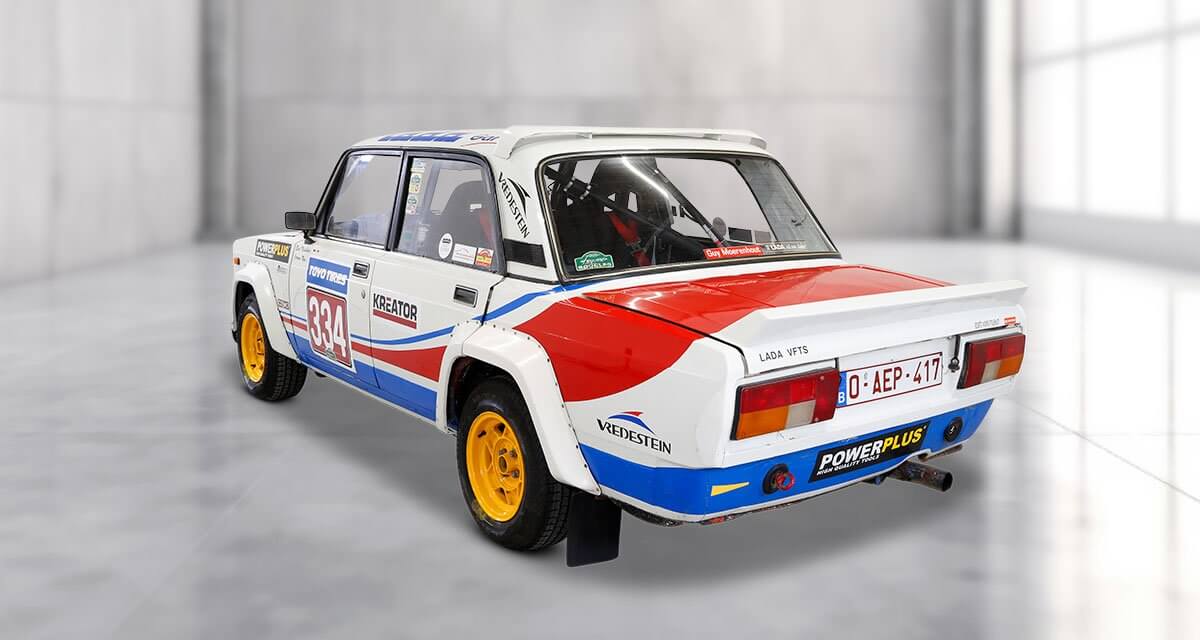
Lada VFTS: From 75 hp to 180 hp for Group B RallyThe VFTS rally car was based on this 2105. VFTS stands for Vilniusskaja Fabrika Transportnych Sredstv, which was based in Vilnius and had close ties to Lada. The company was founded and led by the famous Lithuanian rally driver Stasys Brundza. The Lada VFTS complied with Group B regulations. During the development of the VFTS, efforts were made not only to boost power — which increased from the original 75 hp to between 160 and 180 hp, partly thanks to the use of two twin Weber carburettors — but also to reduce weight, down to 920 to 950 kilograms, by installing side windows made of plexiglass or polycarbonate. |
 |
 |
Lada VFTS: Tight Rally Configuration and Distinctive FeaturesThe suspension has been modified, including the addition of twin trailing arms at the rear. The interior is entirely competition-focused, with a mandatory roll cage, well-contoured bucket seats, and a custom-made dashboard. The gear lever is flanked by a prominently positioned handle for the hydraulically operated handbrake. Externally, the VFTS is identifiable by its front and rear spoilers, extra air intakes on the bonnet, and the angular wheel arch extensions that allow for the fitting of larger wheels. |
Lada VFTS: From Russia to Belgium with Success in Rally SportThe VFTS on display in the museum arrived in the Netherlands from Russia via Scaldia Volga. Mr Meyers, who was a Lada dealer, competed in many races in both the Netherlands and Belgium with this car. Since GMR (Guy Moerenhout Racing) supplied parts to the Meyers garage, GMR was able to purchase the car. GMR has regularly entered it in rallies and achieved, among other results, a second place in the Rally Legend Boucles de Spa. |
 |