
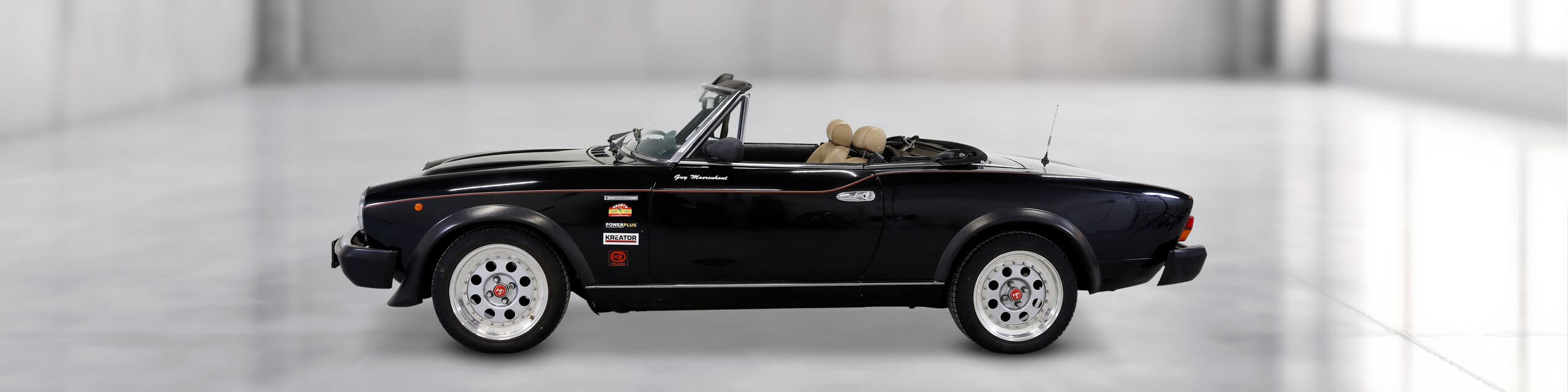
For Fiat, 1966 was undoubtedly the year of the 124, which made its public debut at the Turin Motor ShowIn fact, it was more than just one model. In addition to the sleek four-door and estate versions, which served as the basis for the VAZ 2101 — better known to us as the Lada — there was the aesthetically stunning 124 Sport Spider, followed a year later by the 124 Sport Coupé. The 124 Sport Spider was an open two-seater and a competitor to the MG B and the Alfa Romeo Spider. The design came from Pininfarina, and more specifically from Tom Tjaarda, an American designer who originally worked for Ghia and moved to Pininfarina in 1961. |
 |
From Fiat to Pininfarina: The Evolution of the 124 Sport SpiderThe 124 Sport Spider was initially launched as a Fiat. That changed in 1981. From then on, the successful two-seater was rebranded as the Pininfarina Spidereuropa. Pininfarina was also responsible for the production. With the name change, the Spider received a host of updates to bring it back in line with the times. Its well-executed overall lines were retained. |
The Final Evolution: Pininfarina Spidereuropa and the Exclusive Volumex EditionCosmetic changes were limited to the lights, bumpers, door handles, wheels, and the grille. The interior was also upgraded, and externally adjustable side mirrors made their appearance. The Spidereuropa was equipped with a 2.0-litre fuel-injected engine with twin overhead camshafts and 105 hp delivered to the wheels. In 1983, Pininfarina launched a special edition — the Spidereuropa Volumex. Production was limited to just 500 units, each individually numbered. The 2.0-litre engine was tuned by Abarth and fitted with a mechanically driven Roots supercharger. This provided extra power, peaking at 135 hp. As a result, the Volumex was more powerful than its direct rival, the Alfa Romeo Spider. |
 |
 |
The Unique Spidereuropa Volumex: Power and ExclusivityLet’s not forget that Alfa Romeo was not yet part of the Fiat group at that time. With its extra power, the Volumex reached a top speed of 190 km/h. Thanks to a rack-and-pinion steering system, the Pininfarina handled much more precisely than the earlier 124 Sport Spiders. Abarth’s influence is highlighted by the inscription on the supercharger housing and the scorpion emblem in the centre of the three-spoke steering wheel. The Spidereuropa Volumex was only available in two metallic paint colours: black and red. In 1985, 25 black examples were delivered, including the one housed in the museum. There was also a choice between versions with or without fog lamps. Visually, the Volumex stands out mainly through its wheels, wheel arch extensions, and the front spoiler beneath the bumper with integrated indicators. |
The End of an Era: The Last Abarth Spider and the Museum CollectionDespite the heavy, American-looking bumpers, all are European versions. The European bumpers are positioned 4 centimetres closer to the bodywork than the American ones. The Volumex was the last Abarth ever produced. Ultimately, production of all Spiders came to an end in 1985. Over the span of 19 years, more than 200,000 Spiders were built. The black Volumex in Lier is part of the museum collection, while the red one is on loan from Bruno Van Ballart. A second red example with only 43,000 kilometres and two previous owners has recently joined the collection. |
 |