
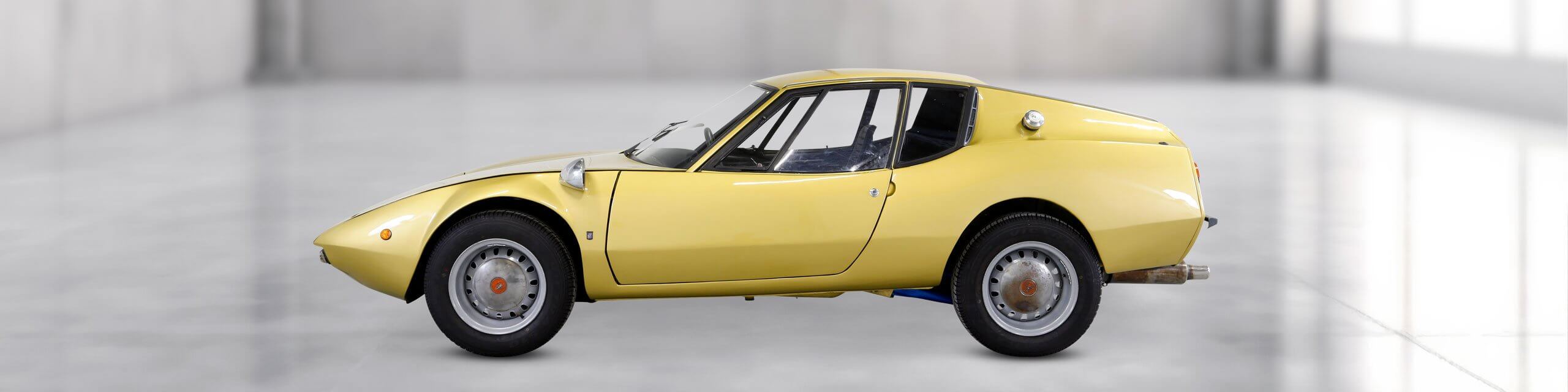
The Abarth 1300 Scorpione and the more powerful SS variant are based on the Lombardi Grand Prix, a compact two-seater coupé with a particularly low rooflineDevelopment took place at Carrozzeria Francis Lombardi. The bodywork design is by Giuseppe Rinaldi, who was on the payroll at Lombardi. The Lombardi used the suspension and engine of the Fiat 850, initially producing a modest 37 hp, and later, in a second phase, a slightly more convincing 47 hp. |
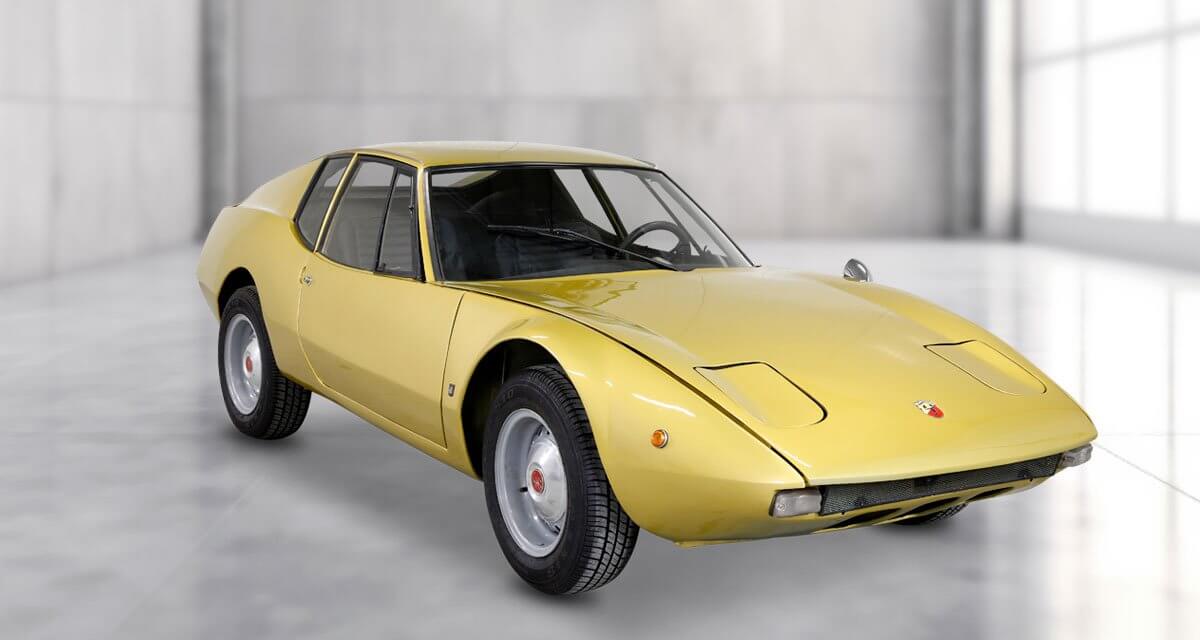 |
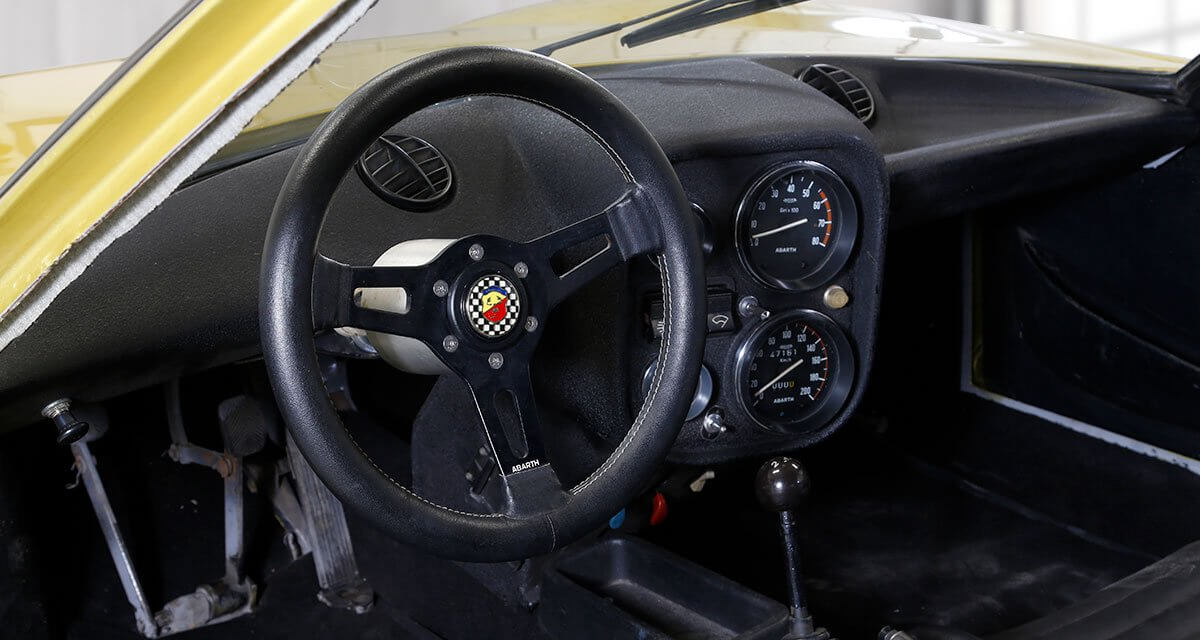
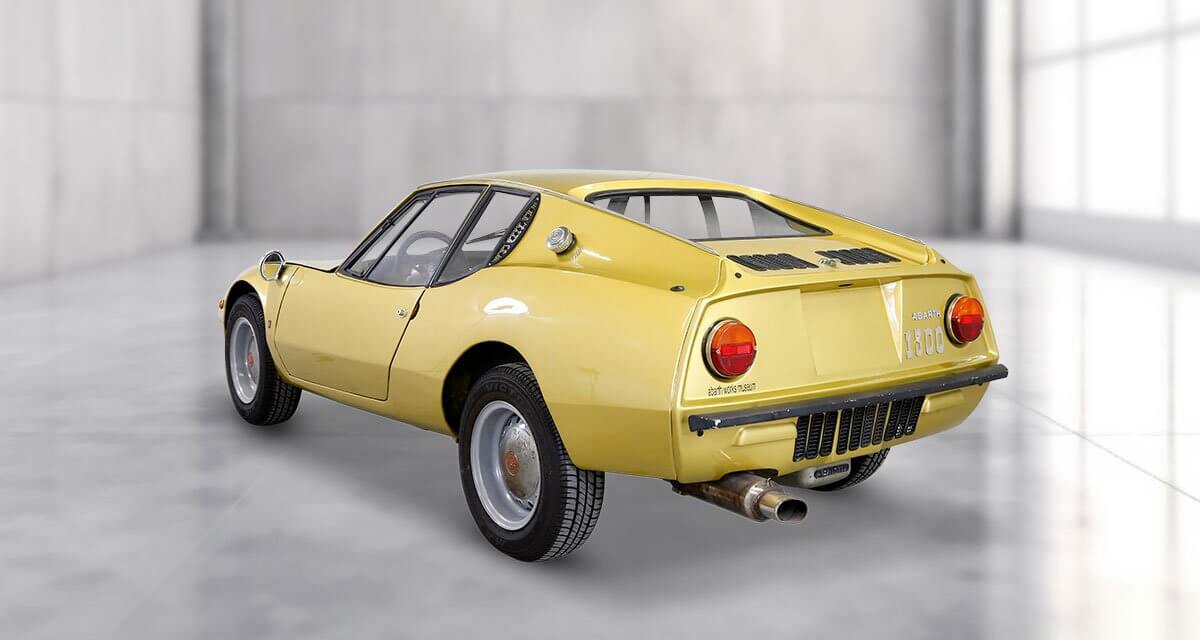
Lombardi Grand Prix: unique appearance and design featuresThe Lombardi Grand Prix and its derivatives, including those by Abarth, have a distinctly individual appearance characterised by a long wedge-shaped nose housing pop-up headlights. Except for the aluminium engine lid, the bodywork is made of steel. A link with the Fiat 850 is revealed by the round rear lights. Due to the low, far-reaching windscreen with a single central wiper, there is no space behind the three-spoke steering wheel for a traditional instrument cluster. All gauges are grouped centrally just ahead of the gear lever in a console angled towards the driver. |
Lombardi Grand Prix: OTAS and Giannini 1000 versions and engine designThe coupé with its distinctive pop-up headlights was also marketed as the OTAS or the Giannini 1000 Grand Prix. OTAS stands for ‘Officina Transformazioni Automobili Sportive’ and was founded in 1969 by Francis Lombardi and engine specialist Franco Giannini, who developed a more powerful 982 cc four-cylinder engine with twin overhead camshafts. For the American and Canadian markets, there was also the OTAS 820 with a reduced engine capacity of 817 cc. By keeping the engine below ‘50 cubic inches’, the OTAS 820 could be sold without additional emissions regulations. |
 |
 |
Lombardi Grand Prix Abarth 1300 Scorpione and 1300 Scorpione SS: engine upgrades and limited productionThe ultimate versions of the Lombardi Grand Prix did not come from Giannini but from Abarth, in the form of the 1300 Scorpione and the 1300 Scorpione SS. Abarth chose the 1.2-litre engine from the Fiat 124 S, which was bored out to a capacity of 1280 cc. This delivered 75 hp in the Scorpione and as much as 100 hp in the Scorpione SS, thanks in part to a higher compression ratio and two twin Weber 45DCOE carburettors. The suspension in the SS was also significantly upgraded. The original transverse leaf spring at the front was replaced with coil springs, while the rear featured the so-called TCR suspension. Anti-roll bars were introduced, and disc brakes were fitted all around. Only about fifteen SS units were ever built, and the example in the museum is one of them. The car ended up in the collection quite by chance. |
Rediscovery of the Abarth 1300 Scorpione SS prototype and its historyIt all began with a search for a windscreen for a Lombardi Grand Prix, which led us to a car in unsuitable John Player Special colours – black and gold – abandoned without wheels at a scrapyard. The owner only wanted to sell the car as a whole and not the windscreen separately. Fortunately, his asking price was reasonable. It later turned out to be an original Abarth 1300 – in fact, the very first one, the prototype – which Carlo Abarth himself drove and is seen with in various photos. The fact that it's a prototype explains why the chassis number corresponds to a Fiat 850. The fully restored Scorpione SS has already participated in several hill climb events in Belgium. |
 |